
StarCraft is a military science fiction media franchise, created by Chris Metzen and James Phinney and owned by Blizzard Entertainment. The series, set in the beginning of the 26th century, centers on a galactic struggle for dominance among four species—the adaptable and mobile Terrans, the ever-evolving insectoid Zerg, the powerfully enigmatic Protoss, and the "god-like" Xel'Naga creator race—in a distant part of the Milky Way galaxy known as the Koprulu Sector.
The original game and its official expansion have been praised as one of the benchmark real-time strategy games of its time. The series has gathered a solid following around the world, particularly in South Korea, where professional players and teams participate in matches, earn sponsorships, and compete in televised matches. By June 2007, StarCraft and Brood War had sold nearly 10 million copies combined. In addition, the series was awarded a star on the Walk of Game in 2006, and holds four Guinness World Records in the Guinness World Records Gamer's Edition of 2008.
 Terran
The terrans are a young species with psionic potential. The terrans of the Koprulu sector descend from the survivors of a disastrous 23rd century colonization mission from Earth. Compared to the protoss and zerg, the terrans are highly factionalized and endure frequent wars amongst themselves in addition to the more recent conflicts with their alien neighbors. Nevertheless, terrans stand as one of the three dominant species of the galaxy.
History:
The terrans arrived in the Koprulu sector via supercarriers in 2259, landing on three separate planets – Tarsonis, Moria and Umoja. They were cut off from Earth. The terran colonists had access to stores of fertilized eggs and frozen embryos, and even extensive cloning, using technologies found on the supercarriers. The terran population expanded rapidly for at least three generations, and for the first five or six generations there was pressure to have many children. Eventually the supercarrier technology broke down.
Prior to the Great War, the terrans were primarily divided into three factions in the Koprulu sector, each based on one of the original settled planets – the Terran Confederacy, Kel-Morian Combine and Umojan Protectorate. The Confederacy was the strongest faction.
During the Great War, the Terran Confederacy, experimenting with psi emitter technology, bore the brunt of attacks by the zerg (infested planets were frequently purified by the protoss) while facing the Sons of Korhal. The Sons of Korhal eventually destroyed the Confederacy by using stolen psi emitters to lure the zerg to Tarsonis; the rebels created the Terran Dominion, based on Korhal, to replace the Confederacy.
Unknown to the terrans of the Koprulu sector, the humans of Earth were aware of their existence. However, no interference came from Earth until the discovery of the alien invaders, sparking panic. The new Earth government, the United Earth Directorate, dispatched an Expeditionary Fleet to take control of the sector and defeat the aliens. After approximately six months of stability, the Dominion came under attack by the UED. Ultimately the sector escaped UED control, but it left the Dominion weak and with the zerg as the sector's dominant power.
By the Second Great War, the Dominion was the strongest terran force in the Koprulu Sector, vying with the Kel-Morian Combine and the Umojan Protectorate for influence. On the eve of war, Raynor's Raiders resumed its anti-Dominion campaign after a period of relative inactivity. The terran polities were engulfed at the start of the Second Great War by a massive zerg invasion. Sarah Kerrigan's objective was the recovery of the Keystone, and the invasion was a way of searching for it. Billions of terrans were killed. Ultimately, the terrans survived the conflict, but at great damage to the Dominion, and the loss of Emperor Mengsk.
Culture:

Terrans are an ingenious and industrious species. It can be said that for terrans, honor is less important than getting results.
Before the founding of the United Powers League, terrans possessed a diversity of beliefs; beliefs that were subsequently repressed. This remained true with the Terran Confederacy, which had limited tolerance for "other faiths". However, a few planets in the Koprulu Sector, notably the Fringe Worlds, have resurrected old Earth religions, Christianity among them, in addition to creating cults, the Church of Besainted Pelagius being one example. For more agnostic societies, some terrans still believe in the existence of a monotheistic deity, though others are distinctively skeptical.
Despite fragments of Earth's history being absent from terran records, some ancient mythologies are still remembered. These include tales of various afterlifes and their dark alternatives, including Hell, Tartarus and Sheol. "Warrior women" are remembered from at least one mythology and elements of Greek mythology have been retained also.
At least in the Koprulu sector, terran cuisine is highly varied. Many terrans pursue consumerism.
One belief, or rather hope that has remained more-or-less constant for humanity is a fascination with the existence of other sapient life – a hope that remained unfulfilled until contact was made with the protoss and zerg. The leaders of the United Powers League were of a different mindset than their Koprulu counterparts, demonstrating a purely militaristic and xenophobic approach to the discovery of alien species.
If one takes an outsider's view on humanity, (e.g. a protoss's), then humanity possesses a wide, puzzling spectrum of morality. When compared to the elder species, terrans are far more obsessed with the notion of private thought and personal freedom and are "not meant for" the unity the Khala brings. Having experienced it however, a terran ghost theorized humans could become a better people were they able to share the psionic link. Terrans have displayed disregard for the natural world in a manner anathema to the protoss.
Factions:
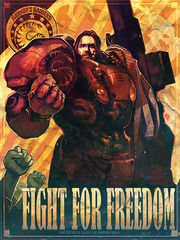
The terrans are a heavily-factionalized species, with many different governments and even more groups trying to overthrow said governments. The three dominant factions in the Koprulu sector are the Kel-Morian Combine, Terran Dominion and the Umojan Protectorate, the Dominion having taken the place of the now defunct Terran Confederacy. Earth and its colonies are controlled by the United Earth Directorate, though this is not absolute. It has been speculated that if ever humanity united under a single banner, it could become an unstoppable force.
Many rebel groups sparr(ed) with colonial powers, which have had varying degrees of success in achieving their goals. Hardly a week goes by without there being some military or policing action being reported in the Koprulu Sector. Military cohesiveness within units however, makes terrans a force to be reckoned with.
Technology:
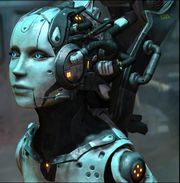
On the galactic scale, terrans are perhaps a "middle of the road" species and something of a paradox technologically. Of the galaxy's sapient species, terrans are significantly inferior to the likes of the protoss yet (seemingly) more advanced than other sapients. From an outsider's point of view, humanity has paradoxically improved its technology despite being in an apparently constant state of conflict. From an insider's point of view, such development has been possible not in spite of conflict, but because of it.
Terrans have a vast assortment of weapons and vehicles at their disposal, and they're always trying to create more powerful weapons. Fare gauges, terrain mappers, and targeting systems are standard for terran fightercraft. Their armies possess both adaptability and resilience. Terran technology includes FTL transmission and sensor technology.
 Zerg
The Zerg Swarm is a terrifying and ruthless amalgamation of biologically advanced, arthropodal aliens. Dedicated to the pursuit of genetic perfection, the zerg relentlessly hunt down and assimilate advanced species across the galaxy, incorporating useful genetic code into their own. They are named "the Swarm" per their ability to rapidly create strains, and the relentless assaults they employ to overwhelm their foes.
Alongside the protoss and terrans, the zerg stand as one of the three dominant species of the Milky Way and are universally feared, hated and hunted as such. The Swarm in itself makes up a third of the power of the Koprulu Sector. Zerg remain in areas of the galaxy outside the Koprulu sector.
History:
Creation of the Swarm:
Amon's xel'naga discovered the original zerg on Zerus. The fallen xel'naga directly intervened in the zerg's development to gift them with the purity of essence, making them the counterparts of the protoss, gifted with the purity of form; the zerg and protoss were intended to eventually merge to form a hybrid army for Amon. At this point the zerg species diverged into two distinct branches; the Zerg Swarm that had been altered and the primal zerg that managed to avoid the tampering of Amon's xel'naga. The xel'naga created the Overmind to control the zerg swarm and prevent a repeat of the protoss' Aeon of Strife. The Overmind oversaw the zerg swarm's rapid evolution, created the cerebrates, and divided the Swarm into broods. The primal zerg, meanwhile, went into hiding to preserve their individuality.
However, the xel'naga in Ulnar caught wind of Amon's plan, and sought to stop Amon from ending the Infinite Cycle. The two factions fought in the space above Zerus, and the swarm was released on the xel'naga. Most were slain and their knowledge was assimilated by the swarm. Through this, the Overmind became aware of the existence of the protoss, and through them sought to make the Zerg Swarm perfect. However, it was aware of the directive implanted into it by Amon, and sought ways to subvert Amon's plans.
The Great War:
Having assimilated multiple species and evolved during the journey, the Swarm arrived at the Koprulu sector near the Protoss Empire. The Overmind ordered the assimilation of the terrans; their psionic potential was needed to fight the protoss. The protoss detected the zerg, learned of their xel'naga origins, and dispatched the Koprulu Expeditionary Force under Executor Tassadar to deny the zerg a foothold.
The Great War broke out with the zerg invasion of the terran worlds. Protoss purification, and terran internal strife, failed to contain the invasion. The terran rebel group, the Sons of Korhal, used and manipulated the invasion to overthrow the Terran Confederacy and form the Terran Dominion. The zerg captured Sarah Kerrigan at the Battle of Tarsonis and withdrew to Char to transform her into the Queen of Blades. The Overmind intended Kerrigan to succeed it as the Swarm's leader, freeing the zerg from Amon. It had no concern over the other races of the galaxy.
The zerg were attacked on Char by the protoss; a renegade Tassadar joined forces with Dark Prelate Zeratul on Char. Zeratul, wielding the Dark Templar's power of the Void, permanently slew Zasz. This created a brief mental link between Zeratul and the Overmind, through which the Overmind learned the exact location of Aiur. Kerrigan remained on Char while the Swarm invaded Aiur.
Resistance against the zerg invasion was hampered by the protoss Conclave's overconfidence and a short protoss civil war. The planet was devastated. The Overmind relocated to Aiur, where it was slain by the protoss. The protoss subsequently withdrew to Shakuras, the Dark Templar homeworld.
The Brood War:
The Overmind's death left the Swarm divided between the cerebrate Daggoth and Kerrigan. Daggoth initiated creation of the second Overmind. Kerrigan sought to kill the Overmind before it could mature and resume control over the entire Swarm and her. The zerg civil war was complicated by the arrival of the United Earth Directorate Expeditionary Fleet in the Koprulu sector; the UED overthrew the Terran Dominion, and captured the second Overmind with the intent of using the zerg to maintain control over the Sector. The UED used the psi disrupter to fragment opposing zerg.
Kerrigan manipulated both anti-UED terrans and the protoss to destroy the Psi Disrupter, break UED control over the sector, and slay the Overmind, thus bringing the entire Swarm under her control. Zerg betrayal dissolved the alliances of convenience. The reformed Terran Dominion, UED remnants, and protoss attempted, and failed, to oust Kerrigan. The war ended with all sides withdrawing to rebuild; the zerg remained in control of previously infested worlds.
Interbellum:
For the next four years, the Swarm avoided outright conflict with the terrans and protoss while slowly expanding and evolving. The remaining cerebrates died and were replaced by broodmothers.
As the first hybrids became active, signs of Amon's machinations reached Kerrigan. While searching for clues about the hybrids, Zeratul discovered Kerrigan was essential to prevent the Swarm from fulfilling the Dark Voice's apocalyptic plans; the dark templar instructed Jim Raynor, of Raynor's Raiders, to ensure Kerrigan's survival.
The Second Great War:
The Second Great War began with the Swarm's invasion of terran space in search of a xel'naga device. Various terran groups used the upheaval to their own ends. Raynor's Raiders fomented rebellion against the Terran Dominion and, on behalf of Crown Prince Valerian Mengsk's Moebius Foundation, recovered the device before the Swarm. A joint Raiders and Dominion attacked Char and used the device to deinfest Kerrigan. The Swarm fragmented.
Kerrigan was doggedly pursued by the Dominion, which led to Raynor's capture and reported execution by the Dominion. Kerrigan began reuniting the Swarm as a tool for vengeance, both for herself and for Raynor. During this period, the Swarm journeyed to Zerus, where it was reunited with the primal zerg and Kerrigan became a primal zerg-human hybrid. Her new form was more powerful than the previous hybridization, and free of Amon's influence.
The Swarm discovered and destroyed a secret Dominion hybrid production facility led by Doctor Emil Narud, a servant of Amon. Kerrigan killed Narud, and learned of Amon's resurrection and the threat he posed to creation. She directed the Swarm to wage war against Amon after killing Mengsk.
The campaign against the Dominion was a success. Raynor was found alive and rescued from a secret prison. The Swarm invaded Korhal, and Kerrigan personally entered the Korhal Palace and slew Emperor Arcturus Mengsk. The Swarm departed Korhal to fight Amon.
The End War:
Zerg under Kerrigan's command assaulted a Moebius Foundation base whose personnel had come under the thrall of hybrids. It was successfully destroyed. Afterwards Kerrigan sent the zerg toward Ulnar, but were engaged by Amon's hybrid.
During the Reclamation of Aiur, the Daelaam fought what it thought was feral zerg on the surface of Aiur. However, these had fallen under the control of Amon's hybrid, and used tactics against the Daelaam. As Amon rose and corrupted the Khala, Amon Brood pushed Hierarch Artanis's few remaining loyalists with the help of the hybrid and corrupted Khalai, forcing him to leave Aiur on the Spear of Adun.
Amon then reactivated the warp gate linking Aiur to Shakuras, and sent billions of zerg to Shakuras. The Daelaam evacuated what population they could, but the planet had been infested. In a last ditch move, Matriarch Vorazun ordered the xel'naga temple's phase prism overloaded, destroying Shakuras and all zerg on the surface.
Kerrigan's swarm continued to battle at Ulnar, and were met with the Daelaam who helped her push into the Temple of Unification. They broke through Moebius Corps, Tal'darim and hybrid forces to get to the central chamber, but found the xel'naga inside dead. Amon revealed his trap, and opened a void portal. The Zerg Swarm and Daelaam allied to destroy the void crystals powering the portal, but in the process Kerrigan's swarm took heavy casualties.
The Daelaam once again came into conflict with Amon's zerg on the planet Endion, where the zerg infested the surface. The Daelaam pushed through their hives to activate the stasis locks keeping the Purifier station of Cybros in orbit, eventually clearing the hives. However then the stasis lock fell Amon's zerg and hybrid descended on Cybros, and began to attempt to destroy the station's power core. However, the Daelaam activated the Purifiers, who cleansed the zerg from the platform, then purified the surface of Endion of all life, destroying the zerg infestation on the surface.
Upon the Daelaam's return to Aiur, Amon's zerg made up the bulk of the defenses. They had infested Antioch and fought to defend the khaydarin crystal that powered the psionic matrix there, but were beaten back by Matriarch Vorazun and Highlord Alarak. The zerg brought up heavy defenses for the last crystal as well, but a combined Daelaam force lead by Hierarch Artanis cut through them and destroyed the crystal.
Amon's zerg served as part of his defensive line defending his host body, alongside shadows of the Void and corrupted Khalai protoss. These were no match for the Daelaam, who destroyed the host body. Amon's brood then converged on the Daelaam as they prepared the Keystone to pull Amon from the Khala, but even with the aid of the Golden Armada could not destroy the Keystone in time. Amon was pushed from the material universe, and the broods on Aiur were out of his control.
Into the Void:
On Ulnar, Kerrigan had managed to rebuild her broods, and sensed a benevolent voice calling to her from the Void. She gathered together the Terran Dominion and the Daelaam, and the three factions pushed into the Void to end Amon and find out what voice was calling to them. They used the void portal in Ulnar to go into the Void, but were attacked by shadows of the Void. They kept on the trail of the voice, and found it to be of Tassadar, who was imprisoned by Narud. Kerrigan and Alexei Stukov lead the zerg in the offense against Narud and his Void forces, and with the help of the Dominion and Daelaam pushed to Narud and weakened him. Stukov personally delivered the killing blow as revenge for killing him years earlier.
Tassadar's voice revealed himself to be of Ouros, one of the last xel'naga, who said Kerrigan needed to ascend to a xel'naga in order to continue the Infinite Cycle and beat Amon. Kerrigan began the process of absorbing Ouros's essence, but Amon sent shadows and void thrashers to stop the process. Zagara lead the swarm in the defense of their queen, and were aided by Jim Raynor and Artanis. The transfer of essence was completed, and Kerrigan ascended to become a xel'naga. She stated that Zagara was now in charge of the swarm, and that she needed to remember the lessons Kerrigan had taught her.
Kerrigan took her broods and directly engaged Amon, supported by the Terran Dominion and Daelaam. Her swarm destroyed the void crystals shielding him, and Kerrigan delivered the killing blow against Amon. With Amon's fall, the swarm returned to the Koprulu Sector.
A New Queen:
By 2508, the Zerg Swarm was unified under Broodmother Zagara. This year, a ceasefire was declared between the Swarm, the Daelaam, and the Dominion. She forcibly laid claim to Char and all of the surrounding worlds, bringing the ceasefire into question. Before Kerrigan departed from the swarm, she gave Zagara two gifts, one was the ability to choose the zerg's fate for themselves, to potentially lead them away from their warlike ways. The second was the location of creature that could house xel'naga essence. Zagara had what essence she could gathered from Ulnar, but there was only a limited amount.
At some point, the zerg attacked a Umojan Protectorate expedition to Jarban Minor, infesting most of the research team.
Years later a terran separatist group known as the Defenders of Man began planting psi-emitters on Dominion planets, prompting feral zerg to attack. The feral zerg struck Antiga Prime first, then the colony of Bountiful. Emperor Valerian Mengsk affirmed to his people that the Dominion was not at war with the Zerg Swarm. Each time, the Defenders of Man would arrive to repel the zerg, as a motion to show how weak the Dominion was in the face of an alien invasion. Psi-emitters were planted on Borea, and the Dominion was forced to evacuate. Finally, the feral zerg struck Tyrador IX in number when several psi-emitters were planted, but were attacked by the Tal'darim Death Fleet. After the Dominion defeated the Tal'darim, the Defenders of Man fleet sent to rescue the civilians defeated the feral zerg.
By 2512, Zagara's experiments with fusing zerg and xel'naga essence had seen fruition. Under the direction of Abathur, the swarm created the adostra, a creature that could generate life on planets passively as the xel'naga did. Abathur however despised these creatures, and Zagara's peaceful stance, which he saw as contradictory to the Swarm's purpose of domination. In response, Abathur siphoned off some of the xel'naga essence, and instead made a breed named the chitha, zerg that could be verbally commanded and had a strong psionic presence that could disrupt communication and other psionic beings. He modified a queen named Mukav, and brought her to his side, and set about his plot to spark a new war.
Zagara used the adostra to regenerate the planet of Gystt, which had been purified in the Great War. The adostra turned the planet into a vibrant jungle, fresh with life. Soon the Daelaam arrived, seeking to purify the planet, so Zagara sent a message to Emperor Valerian Mengsk of the Terran Dominion asking for aid. He arrived, and she extended a hand of diplomacy, saying the Swarm had changed and that she would be willing to help the ailing factions rebuild their planets as she had Gystt. Though skeptical, Artanis and Valerian agreed to meet with her as long as they could survey the planet.
However, Abathur soon put his plans into motion, using his chitha to force the terrans and protoss to destroy two of the three adostra nests, hoping to respark hostilities. This enraged Zagara, but the three factions were able to intervene before the last nest was destroyed, hold off the chitha, and discover Abathur's plot. Zagara and the survey team slew Mukav and the remaining chitha, and incapacitated Abathur. Zagara refused to kill Abathur, but said he would be kept in a place where he could do no more harm.
With the One-Day War resolved and true war adverted, peace talks began between the three factions, with the Swarm offering to aid in reconstruction efforts if they Daelaam and Dominion provided aid for them as well.
Characteristics:
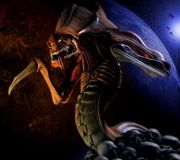
A great deal of information has been ascertained as to the nature of zerg physiology and psychology, such as through the Terran Confederacy's Project Bellwood, and the Terran Dominion's Project Blackstone. All zerg breeds are efficient killers and/or possess abilities that will aid the Swarm in the destruction of its enemies.
Physiology:
The primal zerg maintain the genome of the zerg species before the creation of the Overmind. After this, when the zerg deviated from their primal counterparts, the Swarm reduced their physical appearance to essential fighting components. They excel in proliferation, per their high rate of reproduction. The zerg as a whole are extremely tough, tenacious, and deadly. Their natural armor and weaponry is comparable to modern technology in terms of toughness and armor-piercing capabilities. The zerg are extremely resistant to chemical agents, but their biological nature still renders them vulnerable to concentrated radiation, such as sigma radiation.
All zerg strains are capable of operating in a variety of environments, and some can operate in the vacuum of space. Most zerg are not adapted for space travel by themselves, but are carried by larger zerg such as leviathans. Space-borne zerg either have vast stores of oxygen or have been adapted to not require it.
Zerg must eat and rest, but do not require extended hours of sleep and have no set periods of inactivity. Left unchecked, zerg multiply at an alarming rate. Zerg strains gain nutrients from creep, but can consume other animals for nourishment if the situation demands it. Zerg do not die of old age.
Most zerg ground strains are also capable of burrowing and digging through virtually any surface, using groups of tiny muscles that vibrate at a low frequency and grind dirt and stone along their way, allowing them to "swim through the ground". This ability made them extremely deadly in ambush situations, as many terran or protoss forces suffered losses when suddenly being surrounded by a mass of enemy zerg units. All zerg ground strains move faster on creep than they do on normal ground due to microscopic filaments within the substance that allow them to 'skate' over it. In a protracted fight, one of the Swarm's greatest battlefield advantages is their underground rapid transit system which they can excavate with amazing speed. During the Great War and Brood War, this was provided for by the nydus canal. As of the Second Great War, this has been supplanted by nydus worms, spawned by the nydus network.
Zerg possess remarkable regenerative capabilities. Their alpha amino acids possess unique R groups that allow dead cell matter to be combined with normal proteins to create new cells. Under normal circumstances, zerg may regenerate indefinitely; a radically changing cell structure is a by-product of the process, as well as high quantity of energy in the process. Given time, even a gravely wounded zerg will return to full health. Thus, a zerg colony remains viable if even one creature or structure survives. Few zerg survive for more than a few minutes in a given battle, but those that do evolve during the battle itself, becoming more powerful every hour. The zerg constantly study their enemies and adapt accordingly.
Zerg structures are essentially giant organs and draw sustenance from creep, a thick carpet-like substance that integrates a colony's structures as one macro-organism. Compound B-5801 provides their structural basis.
The zerg are obsessed with detecting subtler motions and more advanced camuflauge techniques.
Genetics:
Before hatching, a zerg specimen has two cell types in general: Type A creates random different mutations, while B cells hunt the new mutations. Upon hatching, the specimen of a certain strain is a result of the Darwin's theory of evolution on a cellular level; it is made of the strongest cell mutations that survived.
Like terrans and protoss, zerg genetic material consists of DNA, seemingly in the shape of a double helix. However, when a zerg strain's DNA evolves, it becomes less flexible. Apart from the overlord, every zerg strain ever encountered by terrans has been a custom mix of DNA, to the extent that no non-overlord strain bears much genetic resemblance to the organism(s) that spawned it. Dr. Talen Ayers theorized that the zerg are unwilling to too deeply alter the genetic makeup of organisms with psionic potential, as even the slightest of genetic changes can remove said potential. This would, in his mind, explain the genetic similarities in this case.
The zerg like to pit themselves against harsh climates, using a planet's harsh conditions to further their own evolution. In regards to assimilating the genetic material of other species, the zerg were initially very selective, assimilating only strong species at the top of their food chains and eradicating 'lesser species' lest they corrupt the purity of the zerg genome. Under Kerrigan, the situation changed, and the zerg were willing to assimilate any material they came across. The zerg genetic landscape is constantly changing, to the extent where using terms such as "mutant" (mutation being a permanant change to an organism's genetic code) can be considered to be a misnomer.
Zerg DNA is "antithetical" to protoss DNA and they cannot infest protoss under normal conditions. In addition, protoss psionic powers (Khala and Void) protect the protoss. The protoss are the only known species that the zerg have failed to assimilate. However, their DNA can be artificially combined, creating hybrids.
Psychology:
It has been difficult for observers to determine the full extent of the zerg intelligence, but it is clear that they are a very cunning species, and they are capable of higher reasoning. Although they do not utilize technology, they demonstrate a clear understanding of it, and have been known to open airlocks and doorways in colonies that they have raided. As a group they also react intelligently to attacks and are adept at tactical combat. On an individual basis, though, the zerg seem to be hardly more than savage animals with little or no concern for self-preservation. Evolution is directed by "Alpha Zerg" strains, such as cerebrates and queens. Dr. Talise Cogan voiced the idea that the zerg, as a whole, can be considered to be a macro-organism. The zerg can be considered to be a "slave race" to whatever entity controls them.
For the zerg, success on the battlefield comes down to overwhelming numbers and great mobility. For them, war is simply survival of the fittest.
The quest for perfection is rooted deep within the zerg psyche, and is a pseudo-religious concept for them. The core idea of this 'religion' is that there is a state that the zerg can reach where they would no longer need to evolve, that their evolutionary form would never have to change again because they could already adapt to any situation.
The amount of control exerted over a zerg force also impacts on their intelligence. Without this control, the zerg will become little more than animals, attacking everything on sight, at times, even their own kind. These zerg are referred to as feral zerg and can generally only operate at the lowest level. In contrast, primal zerg are intellectual individuals, with no links to a hivemind.
During the Brood War, the Queen of Blades became the uncontested leader of the Swarm. However, creating sapient lieutenants such as broodmothers extended her control over the Swarm even further.
Zerg have the ability to sense psychic power and, being sensitive to it, often respond to it (to the point of rendering themselves temporarily out of the control of a leader) and seek it out. This ability has a greater range than that of wranglers, weakly psychic terrans employed to find other psychics.
Zerg can be "lobotomized" to lose contact with the Zerg Swarm. The Terran Dominion conducted this experiment as early as 2500, using zerglings to seek psychic terrans.

Warp Travel:
The zerg are able to create rifts into warp space to transport themselves at faster-than-light speeds. These rifts have been utilized multiple times.
Worlds:
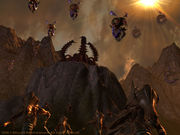
The zerg have demonstrated an ability to storm worlds, but are less well-equipped at holding them. After the Brood War, the Swarm pulled back to Char, but could have easily expanded to cover numerous worlds again. Over 100 worlds have been infested by the zerg.
The following is a list of planets and moons that have been conquered by the Swarm, if only temporarily which can be found here.
 Protoss
.jpg)
The protoss, a.k.a. the Firstborn, are a sapient humanoid race native to Aiur. Their advanced technology complements and enhances their psionic mastery.
The main protoss cultural groups are the Khalai, who adhere to the communal Khala, and the Nerazim, who reject the Khala. In addition, another branch of the protoss separate from the Khala called the Tal'darim lives in various places in the galaxy.
Protoss civilization was reunified when the Khalai and Nerazim, sundered since the Discord, were reunited after the devastation of Aiur by the zerg during the Great War.
Alongside the zerg and terrans, the protoss stand as one of the three dominant species of the Milky Way. Protoss are not found outside the Koprulu sector.
History:
The protoss are an ancient race, and they consider themselves to be the "firstborn" race of the universe.
The protoss were discovered by Amon and his followers on Aiur, a world the xel'naga had previously engineered. The xel'naga, who were nearing the end of their life cycle, were in need of a race to achieve purity of form and intrigued by their mental connection, chose to use the protoss. Amon uplifted the protoss and manipulated their essence. Pushing the evolution of the protoss, the purity of form was achieved and the xel'naga eventually descended to Aiur. The protoss, who revered the Amon and his followers as gods, learned much from them. But in time, they began to grow wary of their creators, and rebelled from them, attacking their ships and killing hundreds. Amon and his followers left the planet as the protoss fell into the Aeon of Strife, a period of brutal civil war. Until the End War, history would hold that it was the xel'naga as a whole that were responsible for this uplift.
The destructive civil war ended when Khas, using xel'naga-derived artifacts called khaydarin crystals, re-created the psionic link. It became the basis of a new philosophy called the Khala.
Approximately 1500 by terran reckoning, the Conclave attempted to exterminate rogue heretics who had deliberately cut themselves off from the Khala and would later become known as the Dark Templar. They ordered Executor Adun to execute them, but Adun refused, instead teaching the rogues to hide from the Conclave. Eventually the rogues lost control of their powers, alerting the Conclave. They were secretly banished on a xel'naga ship.
By 2499 the protoss became aware of a xenomorphic threat, the zerg, another alien species also created by the xel'naga. The zerg were attacking the terrans, a species which had traveled to the Koprulu Sector two hundred years previously. The Conclave dispatched Tassadar and a force of protoss to destroy the infestation by purifying the infested worlds.
Fall of Aiur:

Tassadar's force failed in its mission, and the remnants traveled to the new zerg homeworld, Char. There, Tassadar struck an alliance with the Dark Templar prelate, Zeratul. They discovered a weakness in the zerg command structure which could be exploited only by the Dark Templar, and clashed with their new leader, the Queen of Blades. Meanwhile, the majority of the zerg force traveled to Aiur. The protoss were losing the battle, but when Tassadar brought Zeratul to Aiur, a protoss civil war broke out between Tassadar's followers and the followers of the Conclave. Eventually Tassadar's faction won. Unimpeded by the Conclave, Tassadar's followers attacked the Overmind itself. Tassadar died during the battle. Seventy percent of protoss on Aiur were killed.
The protoss fled to Shakuras, followed by a zerg faction. The protoss destroyed the renegade zerg, saving themselves but advancing Sarah Kerrigan's aims. With the assistance of her enigmatic minion Samir Duran, she would later force the protoss into destroying the second Overmind for her, making her the sole leader of the Zerg Swarm. As the protoss attempted a revenge strike on Kerrigan, Duran abandoned her to conduct protoss/zerg hybridization experiments, which were discovered by Zeratul. The latter exiled himself for several years following the discovery.
End War:
The protoss spent years rebuilding the Golden Armada to retake Aiur, and in 2506, the fleet was launched to retake their homeworld. However, this coincided with the return of Amon, who corrupted the Khala and possessed every protoss connected to it. Artanis gathered the survivors aboard the arkship the Spear of Adun, and set off to find the means to fight Amon. They followed Zeratul's lead to the temple of Ulnar, but found the xel'naga there dead. Artanis then united the ancient Purifiers and the Tal'darim, and moved to reclaim their home. The attack was successful; Aiur was reclaimed and Amon was pushed back into the Void. The protoss, with the aid of the Terran Dominion and Zerg Swarm, pushed into the Void and slew Amon, ending his manipulations of the protoss.
Physiology:
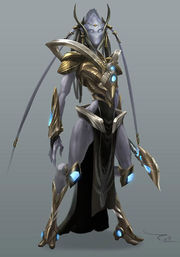
Protoss are about two meters (seven feet) to three meters tall, with typical heights of eight to nine feet (2.4-2.7 meters). The height of researcher Ulavu was given as two and a quarter meters. A protoss would consider a human over six feet tall to be "short".
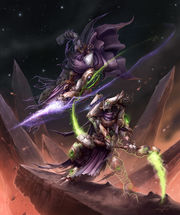
They have two glowing eyes that blink normally, digitigrade legs, semi-permeable skin covered in scales, four digits on their hands (of which two are thumbs) and toes, broad chests and shoulders, and narrow waists with slim midsections. Extending back from the crown of the head, protoss have a bony crest. Beneath it, emerging from the back of the head, are the nerve cords, allowing them to access their racial psionic gestalt. This gestalt is the basis of the Khala.
The xel'naga considered these beings to have purity of form as the protoss are incredibly adaptable to harsh natural conditions and climates, and their strength and speed were unparalleled amongst the other races known to the xel’naga. Protoss even have sharp claws, which can be deadly weapons if a protoss is caught unarmed.
Protoss derive sustenance from light, capable of living off moonlight (reflected sunlight), and can go without light for extended periods of time. What little water they need is absorbed through the skin. The Dark Templar modified themselves biologically and used other techniques to survive on the formerly lightless world of Shakuras. Protoss describe the principle of light absorption to be the same as plants, but over a much wider electromagnetic spectrum.
The protoss used to hunt, but they did so to collect the blood and hides of animals for various purposes, not for sustenance.
Protoss hear and smell through their skin, and it is believed that their primary sense is sight. Protoss have a sense of smell sharp enough to identify other protoss and see very well at night. A protoss' skin color may change in response to changes in its emotions. They are bereft of mouths, noses, or visible ears and are without a sense of taste. They possess three hearts.
Protoss sleep and dream in a manner similar to humans. When particuarly emotional, streams of energy have been observed to stream from a protoss's eyes, similar to how a terran might cry. Eye colors include blue, green, gold, violet, and red. The proliferation of eye color corresponds to kindred; Khalai eyes are predominantly blue, Nerazim are predominantly green, and red is present among the Tal'darim, though has also been observed for the Khalai.
A protoss's maximum life expectancy is 1000 years.
Protoss are not a prolific people and the xel'naga even developed an artifact, the Kassia crystal, to counteract this. The population of Aiur, however, had reached billions. Before the Fall of Aiur, the protoss population was in decline due to systematic extermination; the protoss were passing away from sheer age. Their numbers have been further reduced through conflict, and their population continues to decline.
Protoss blood is blue or purple. As in humans, coloration is considered a sign of ethnicity, with each protoss tribe having a specific subtly differing hue or typical pattern of markings associated with it.
As with terrans and zerg, protoss genetic material consists of DNA with helix strands. There is evidence that the protoss have yet to unlock their full genetic potential, but this theory died along with the Protoss Advance/Experimental Facility.
Protoss DNA is "antithetical" to zerg DNA and cannot be combined through infestation under normal circumstances. Artificial methods can be used to generate hybrids however.
Protoss can bear birthmarks.
Medical Care:
On the battlefield protoss warriors are known to fight with tremendous power and grace, but despite the chaos they inflict on their enemies they are capable of being mortally wounded. When a protoss nears death, their foes often bear witness to a startling flash of bright light as the protoss warrior seemingly disappears. Primitive races are known to quail in superstitious fear upon seeing this, but it is actually another aspect of protoss technology at work rather than any sort of supernatural feat.
Protoss armor is typically equipped with a complex teleportation mechanism that can detect when its wearer is grievously injured and automatically teleports the warrior to the nearest safe haven. This of course is dependent on the mechanism being fully functional, as there is the risk of being damaged during combat.
Those protoss who are too badly injured after the battle but still wish to continue fighting are placed within the shell of a dragoon or immortal, which allows them to serve their brethren on the battlefield. The choice is left to each individual protoss; whether to continue service or join with their ancestors in the Khala.
Protoss that suffer injuries to their psionic appendages (such as the Nerazim) attach clamps to the remnants in order to prevent energy bleed.
Terran understanding of protoss physiology is limited. Their respective biologies are similar enough for substances and drugs, such as Sundrop and a medic's medicine to affect both.
Mental Abilities:
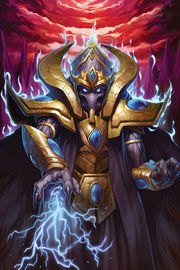
Their powerful psionic abilities extend further than that of human ghosts (Military Unit, not supernatural entities).
Protoss have been described as "devastatingly intelligent", and their thought processes work very differently than those of terrans.
Protoss are natural mind-readers. They must learn to filter the thoughts they read, block and release (which would prevent other protoss from reading their minds). The ability to block thoughts is compromised by the Khala, which prevents the protoss which follow that philosophy from hiding from each other. During the Aeon of Strife, Protoss regularly used their mind-screening abilities to ambush each other.
Protoss can use their psionic abilities to shield themselves, charge their tools and weapons, and to make, manipulate or meld matter. At least some of these abilities can only be used by a small minority of protoss without technological assistance (such as the creation of shields).
Protoss can sometimes access memories and strands of experience from protoss who have died and entered the Khala, but only preservers have full access to this knowledge. Protoss warriors can learn from the spirits of fallen warriors at the Templar Archives.
The powers of the Khala and the Void protect protoss from zerg infestation.
Communication:
Protoss can communicate telepathically with each other. They can do so through "speaking", a method that transmits little or no emotional content. Using their nerve cords they can also communicate in a manner which enables them to sense each others' emotions, a key part of their psionic gestalt, the Khala. During the Aeon of Strife this ability had fallen into disuse, but was restored by the mystic Khas. Protoss who follow the Khala use both methods of communication. Dark Templar ritually sever their nerve cords, which prevents the emotional link.
Protoss can create a special kind of mind-meld deep within the Khala, where no one can lie. Protoss performing this kind of mind-meld hold up their hands and face their palms to each other; both palms softly glow. This kind of communication was also possibly held between Executor Adun and Raszagal, the latter not following the Khala.
Protoss "speak" a language called Khalani, communicating through telepathic bursts. The privacy of the conversation is up to those involved on it. Even through communication, pain can be caused via this telepathy via mental spikes. Terrans exposed to protoss communication often hear nearly meaningless sounds. However, at least some protoss have the ability to "translate" the thoughts into a form which a terran can understand.
The protoss of the Aeon of Strife did not understand the concept of non-psionic communication. Khas effectively (re-)created the concept of reading and writing, a necessity for translating some xel'naga relics.
In addition to telepathy, protoss possess a degree of body language used in conveying feelings, intent, etc. For instance, a bob of the head and movement of a protoss' nerve chords is a sign of contempt. Bowing of the head, shaking and/or mottling of the skin is a sign of emotional distress.
Culture:
Protoss culture is built around core philosophies that have been rigidly adhered to for over a millennium. As such, it is difficult for their society to adapt to changing circumstances. The integration of Khalai and Nerazim is a case in point in different cultural values.
Khalai culture has its roots in the Aeon of Strife, the period of chaos following the retreat of the xel'naga. At the end of the Strife, the protoss were reunited under the precepts of the Khala ("Path to Ascension") as promoted by the mystic Khas. The Khala took advantage of the natural psionic communal link and established a caste system. Protoss can be fanatical when it comes to their religious beliefs.
Not all protoss embraced the Khala. Many outcasts, eventually known as the Nerazim, were later banished from Aiur. Yet other outcasts, the Tal'darim, use drugs to cut themselves off from the Khala.
Female protoss rarely attain positions of power, except among the Nerazim. They are rare among the Templar Caste and were never part of the Conclave. Many protoss have a prejudice against female terrans, as the only one they've had much contact with was Kerrigan (contrasted to Jim Raynor). Very young protoss are referred to as "younglings."
The protoss are considered a "warrior race", although they were not constantly at war. They trained incessantly for combat, however, and prior to the Great War warred with the kalathi and "other types" of protoss. Protoss have a strict code of justice and honor, and strongly believe in their responsibility to enforce it. They strive for glory in battle. For the protoss, discipline and advanced technology are the key to success on the battlefield, and dying with honor is preferable to surviving through cowardice.
Protoss have always been willing to sacrifice their lives for other members of their species. Protoss revel in the glory of personal combat, and consider the ranged weapons of terrans to be cowardly. Nonetheless, they recognize the necessity of ranged warfare, hence the existence of technology such as the photon cannon.
Aiur holds great, almost spiritual significance to all protoss.
The protoss, or at least the Khalai, do not not have a concept of luck, instead seeing "the synchronicity of events," and knowing there is a grander design behind them.
Among the Nerazim, family ties are important, but among the Khalai and Tal'darim, family terms are indirect, and protoss do not form terran-like family units.
Language:
Protoss have a mental language, Khalani, and a written language, which the Nerazim maintained. Khalai can communicate wordlessly due to the properties of the Khala, while Nerazim must voice their words vocally.
Religion:
The protoss as a whole once worshiped the xel'naga as gods. In the present day, various protoss have also referred to the xel'naga as gods, and the Tal'darim have taken a hardline approach to worship of Amon and his follower xel'naga as a deities.
Factions:
The extent to which the protoss have been a unified people has waxed and waned over time. Originally tribal based, the protoss settled under centralized rule with the coming of the xel'naga, only to revert back to tribalism in the Aeon of Strife, only to once again be unified after thousands of years. Under the Khala, the Khalai formed the caste-based Protoss Empire while those who refused to submit became the outcast Nerazim.
In the aftermath of the Brood War, both lines of protoss were united under the Daelaam. However, internal tension once again led to tribalism and their civilization fractured. In the aftermath of the End War, the Daelaam united the remaining tribes, and reclaimed Aiur as the homeland for all protoss.
The Tal'darim are a branch of protoss that were taken from Aiur during the departure of the xel'naga, and serve as a seperate culture from the Khalai and the Nerazim, unconnected to the Khala. They are warlike, and before his fall served Amon with a fanatical devotion, using terrazine to become closer to him.
While not true protoss, the Purifiers were templar designed by the protoss who rebelled over not being treated as true templar. During the End War, they were absorbed back into protoss society with the promise of equal treatment to true protoss.
Technology:
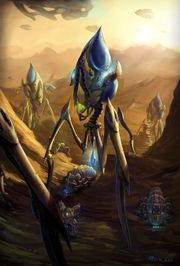
Protoss technology is a blend of psionics and mundane technology and has shown itself to be far more advanced than many other species of the galaxy, including humanity, which was "digging in the dirt for grubs" by the time the protoss had achieved interstellar travel. They have been referred to as "the most technologically advanced race in the universe,"and their warriors are "the best trained in the galaxy."
Some protoss technology requires vespene gas as a catalyst. Protoss utilize cybernetic technology to save lives, and bolster their warriors' prowess. Battlefield communications between protoss are efficient. The use of energy for defensive purposes is a standard protoss practice.
Protoss armor contains teleportation technology which whisks the warrior away to safety when they are injured to the point of death. Injured and crippled protoss can be transformed into cybernetic warriors.
Due to their low population, the protoss frequently use robots in their military. Due to their diminished population, the protoss are in a position of not being able to waste resources.
Protoss pilots are an integral part of their ship, and using it drains their energies. Protoss aerospace craft utilize anti-gravity technology to keep them airborne when operating within a planet's atmosphere.
The protoss developed powerful crystal technology and incredibly powerful weapons of war, such as the colossus and the mothership, and could develop more powerful technology if they wished. The protoss limit their use of technology, as they are frightened of what they could do with it and feel they have perfected a slow but steady and methodical system of technological development. The longevity of protoss history has allowed them to develop incredible weapons of war over the course of it.
Despite the Fall of Aiur, the protoss can still produce starships on other planets, and they have also inventories of them in many places.